K-Means Clustering for N-Dimensional Feature Spaces
Published
•2 min readM
Mohamad's interest is in Programming (Mobile, Web, Database and Machine Learning). He is studying at the Center For Artificial Intelligence Technology (CAIT), Universiti Kebangsaan Malaysia (UKM).
import numpy as np
import matplotlib.pyplot as plt

def kmeans(data, k, max_iter=100):
    # Randomly initialize centroids
    np.random.seed(0)  # For reproducibility
    centroids = data[np.random.choice(data.shape[0], k, replace=False)]

    for _ in range(max_iter):
        # Assignment step
        distances = np.linalg.norm(data[:, np.newaxis] - centroids, axis=2)
        clusters = np.argmin(distances, axis=1)

        # Update step
        new_centroids = np.array([data[clusters == i].mean(axis=0) for i in range(k)])

        # Check for convergence
        if np.all(centroids == new_centroids):
            break

        centroids = new_centroids

    return centroids, clusters

def plot_clusters(data, centroids, clusters, title):
    plt.figure(figsize=(8, 6))
    if data.shape[1] == 1:
        plt.scatter(data, np.zeros_like(data), c=clusters, cmap='viridis', s=100)
        plt.scatter(centroids, np.zeros_like(centroids), color='red', marker='X', s=200, label='Centroids')
        plt.title(title)
        plt.xlabel('Feature 1')
        plt.yticks([])
    elif data.shape[1] == 2:
        plt.scatter(data[:, 0], data[:, 1], c=clusters, cmap='viridis', s=100)
        plt.scatter(centroids[:, 0], centroids[:, 1], color='red', marker='X', s=200, label='Centroids')
        plt.title(title)
        plt.xlabel('Feature 1')
        plt.ylabel('Feature 2')
    elif data.shape[1] == 3:
        ax = plt.axes(projection='3d')
        ax.scatter(data[:, 0], data[:, 1], data[:, 2], c=clusters, cmap='viridis', s=100)
        ax.scatter(centroids[:, 0], centroids[:, 1], centroids[:, 2], color='red', marker='X', s=200, label='Centroids')
        ax.set_title(title)
        ax.set_xlabel('Feature 1')
        ax.set_ylabel('Feature 2')
        ax.set_zlabel('Feature 3')

    plt.legend()
    plt.show()

if __name__ == "__main__":
    # Dataset 1: 1D
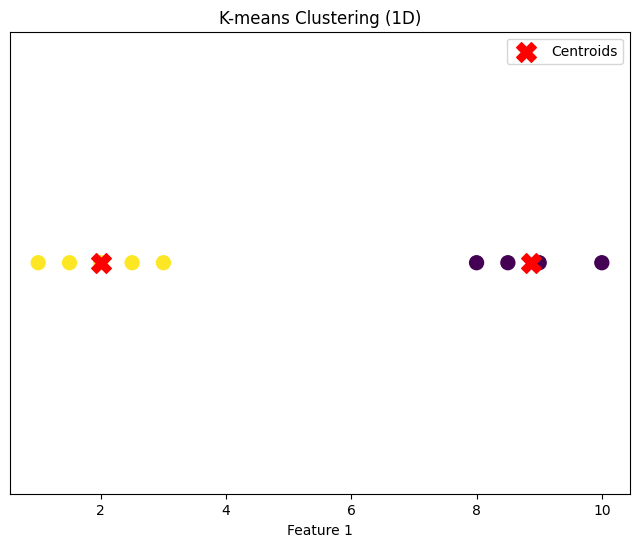
    data_1d = np.array([[1], [1.5], [2], [2.5], [3], [8], [8.5], [9], [10]])
    k1 = 2
    centroids_1d, clusters_1d = kmeans(data_1d, k1)
    plot_clusters(data_1d, centroids_1d, clusters_1d, "K-means Clustering (1D)")

    # Dataset 2: 2D
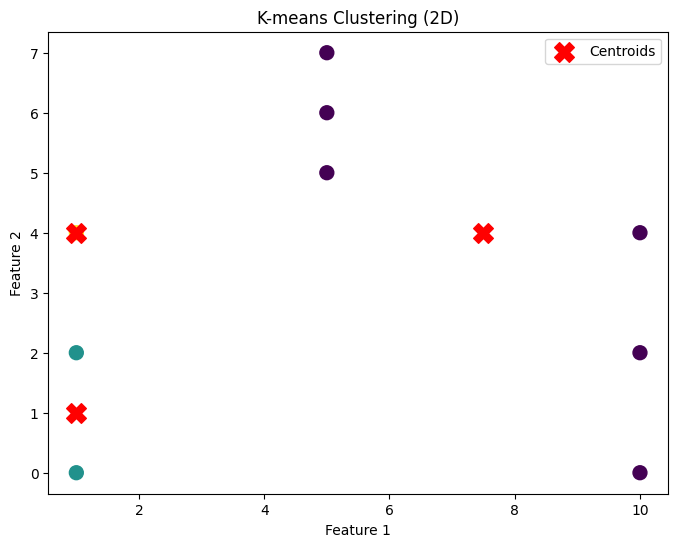
    data_2d = np.array([[1, 2], [1, 4], [1, 0],
                        [10, 2], [10, 4], [10, 0],
                        [5, 5], [5, 6], [5, 7]])
    k2 = 3
    centroids_2d, clusters_2d = kmeans(data_2d, k2)
    plot_clusters(data_2d, centroids_2d, clusters_2d, "K-means Clustering (2D)")

    # Dataset 3: 3D
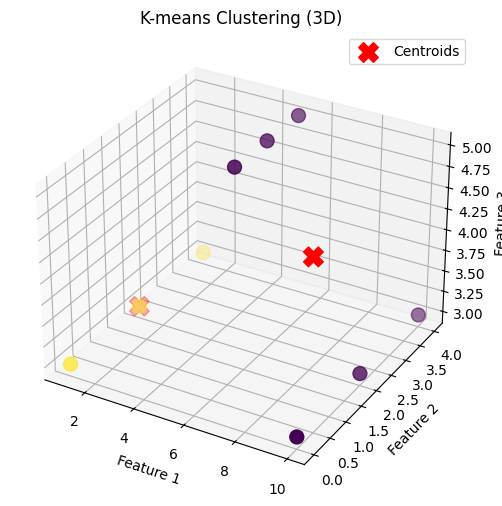
    data_3d = np.array([[1, 2, 3], [1, 4, 3], [1, 0, 3],
                        [10, 2, 3], [10, 4, 3], [10, 0, 3],
                        [5, 2, 5], [5, 3, 5], [5, 4, 5]])
    k3 = 2
    centroids_3d, clusters_3d = kmeans(data_3d, k3)
    plot_clusters(data_3d, centroids_3d, clusters_3d, "K-means Clustering (3D)")
Output:
1 Dimension
2 Dimension
3 Dimension
2 views